

Our Location
Dongguan, China
Call Us
+86 769-85842789
E-mail Us
pw@pw-test.com
Features:There are high temperature area, low temperature area and independent test area. During the test, the sample is placed in the test area and remains still. The temperature shock is achieved by switching the hot and cold air flows through the air door.
Efficiency: The sample does not need to be moved, and different temperature shock tests can be performed by simply switching the air duct. Multiple samples can be tested at the same time, which makes the test more efficient.
Control system: Generally, two independent control systems are required to control the temperature of the high and low temperature zones and the test zone respectively to ensure that the temperature in each zone is accurate and stable.
Application scenarios: More suitable for situations that require a milder temperature shock process and higher test accuracy and sample protection, such as precision electronic components, optical devices, etc.
Cost price: The structure is complex, requiring more components and a more advanced control system, the manufacturing cost is high, and the price of the equipment is also higher.


Perform thermal shock tests on automotive engine control units (ECUs)
If the ECU fails during the test, such as failing to start normally or freezing, the fault needs to be analyzed in depth. The specific location and cause of the fault can be determined by checking the fault code, testing the circuit signal, etc. For faults caused by thermal shock, corresponding measures need to be taken to improve them, such as replacing high-temperature or low-temperature resistant electronic components, optimizing the layout of the circuit board, etc., to improve the reliability and stability of the ECU.

Thermal shock test of high thermal conductivity optical films
Rapid temperature changes can cause high thermal conductivity optical films to expand and contract, thereby generating stress inside the film. Thermal shock tests can check whether the film will suffer structural damage such as cracks, delamination, deformation, etc. due to this stress. If the test results are not ideal, corresponding improvement measures need to be taken, such as optimizing the film preparation process (such as adjusting deposition parameters, adding stabilizers, etc.), improving the material formulation (such as introducing new reinforcing phases or additives), etc.

Solid-state battery cells undergo thermal shock tests
Simulate the sudden temperature changes that the battery may encounter during actual use. This test can quickly detect the battery’s tolerance to sudden temperature changes, focusing on whether the stress generated by thermal expansion and contraction inside the battery will cause structural damage (such as interface separation between electrodes and solid electrolytes, shell cracking, etc.), and the recovery of electrical performance after a sudden temperature change. For example, during the driving process of a vehicle, it may suddenly enter an environment with a large temperature difference such as a tunnel or an underground parking lot. The hot and cold shock test can simulate this situation.

Thermal shock test for outdoor camera housing
Test the tolerance of the materials used in the camera housing, internal circuit boards, lenses and other components in alternating hot and cold environments. For example, check whether the housing material will crack or deform due to thermal expansion and contraction, affecting the protective performance of the camera; whether the electronic components on the circuit board will fail due to temperature changes. If the above problems occur, it is necessary to analyze the causes, improve and optimize the product, such as changing materials, improving structural design, etc., and then re-test.

Field Programmable Gate Array (FPGA) for thermal shock testing
Some high-performance, high-resolution 3D scanners are frequently started in high-temperature industrial environments or low-temperature outdoor environments. The FPGA will generate a lot of heat, and the surface temperature may be 30-50℃ higher than the ambient temperature, or even higher. After the scanning is stopped, the temperature will drop rapidly. In this case, the FPGA must have good resistance to cold and heat shock to ensure the reliability of the scanner and the accuracy of the detection results.

Thermal shock test of medical spray stored at low temperature
Recombinant bovine basic fibroblast growth factor spray can promote wound healing. Growth factors are unstable at higher temperatures and are easily degraded and inactivated. They are usually stored at 2-8°C to maintain their biological activity and stability. When the patient takes it out of the refrigerator and uses it immediately at room temperature or high temperature, such as outdoors in summer, where the ambient temperature may reach over 30°C, the spray will quickly experience a temperature increase. Determine whether the drug ingredients in the spray are stable under conditions of drastic temperature changes, whether they will degrade, deteriorate, or produce impurities, in order to ensure the quality of the drug during actual use and transportation.
Whether to choose a three-chamber or two-chamber hot and cold shock test chamber depends on your test needs, budget and sample characteristics. The following is a comparison between the two:
1. Working principle
Three-chamber: Contains a high temperature chamber, a low temperature chamber and a test chamber. The sample does not move in the test chamber and switches the temperature through the damper.
Two-chamber: Only a high temperature chamber and a low temperature chamber, and the sample moves between the two chambers through a hanging basket.
2. Temperature conversion speed
Three-chamber: The conversion speed is fast, usually completed within 5 seconds.
Two-chamber: The conversion speed is slow, usually taking tens of seconds to several minutes.
3. Sample adaptability
Three-chamber: Suitable for samples that are sensitive to temperature changes, such as electronic components, PCBs, etc.
Two-chamber: Suitable for samples that are not sensitive to temperature changes, such as metals, plastics, etc.
4. Test efficiency
Three-chamber: High efficiency, suitable for tests with frequent temperature changes.
Two-chamber: Low efficiency, suitable for long-term stable temperature testing.
5. Equipment cost
Three-chamber type: high cost and complex structure.
Two-chamber type: low cost and simple structure.
6. Maintenance and operation
Three-chamber type: complex maintenance and high technical requirements for operation.
Two-chamber type: simple maintenance and relatively easy operation.
7. Space requirements
Three-chamber type: occupies a large space.
Two-chamber type: occupies a small space.
Selection suggestions
Choose the three-chamber type: if the test requires rapid temperature changes and the sample is sensitive to temperature.
Choose the two-chamber type: if the test does not require a high temperature change speed and the budget is limited.
Thermal shock test chambers, whether two-zone or three-zone, are designed to meet various international, national, and industry standards to ensure their performance, reliability, and safety. Below is a comprehensive list of standards that thermal shock test chambers typically support:
IEC 60068-2-1: Environmental testing - Part 2-1: Tests - Test A: Cold.
IEC 60068-2-2: Environmental testing - Part 2-2: Tests - Test B: Dry heat.
IEC 60068-2-14: Environmental testing - Part 2-14: Tests - Test N: Change of temperature.
ISO 16750-4: Road vehicles - Environmental conditions and testing for electrical and electronic equipment - Part 4: Climatic loads.
GB/T 2423.1: Environmental testing for electric and electronic products - Part 2: Test methods - Test A: Cold.
GB/T 2423.2: Environmental testing for electric and electronic products - Part 2: Test methods - Test B: Dry heat.
GB/T 2423.22: Environmental testing for electric and electronic products - Part 2: Test methods - Test N: Change of temperature.
GB/T 10592: Technical specifications for high and low temperature test chambers.
GB/T 5170.2: Inspection methods for basic parameters of environmental testing equipment for electric and electronic products - Temperature testing equipment.
MIL-STD-810: Environmental Engineering Considerations and Laboratory Tests (US Military Standard, includes temperature shock testing).
JIS C 60068-2-14: Environmental testing - Part 2-14: Tests - Test N: Change of temperature (Japanese Industrial Standard).
GJB 150.5A: Environmental test methods for military equipment - Temperature shock test (Chinese Military Standard).
ASTM D618: Standard Practice for Conditioning Plastics for Testing (includes temperature shock considerations).
EN 60068-2-14: Environmental testing - Part 2-14: Tests - Test N: Change of temperature (European Standard).
Temperature Range: The extreme high and low temperatures the chamber can achieve.
Temperature Uniformity: Typically ≤ ±2°C.
Temperature Fluctuation: Typically ≤ ±0.5°C.
Temperature Transition Time: Usually within 5 seconds for three-zone chambers and within minutes for two-zone chambers.
Recovery Time: Time to stabilize at the set temperature, usually within 5 minutes.
CE Marking: Indicates conformity with health, safety, and environmental protection standards for products sold within the European Economic Area.
RoHS Compliance: Restriction of Hazardous Substances directive.
UL Certification: Underwriters Laboratories certification for safety.
JJF 1101: Calibration specification for environmental testing devices with temperature and humidity.
ISO/IEC 17025: General requirements for the competence of testing and calibration laboratories.
Thermal shock test chambers support a wide range of standards to ensure they meet the rigorous demands of various industries, including electronics, automotive, aerospace, and materials testing. When selecting a thermal shock test chamber, it is crucial to verify that it complies with the specific standards relevant to your testing requirements. This ensures the accuracy of test results and the reliability of the equipment.
🔹 Function: Protects the test sample from excessive heat exposure by setting an upper temperature limit.
🔹 Analysis: This feature is crucial for preventing damage to sensitive electronic components, plastics, and coatings during testing. If the product’s temperature exceeds the limit, the system can shut down or adjust heating accordingly.
🔹 Function: A fuse that trips when the chamber's internal temperature exceeds a critical threshold, cutting off power to prevent overheating.
🔹 Analysis: Acts as a fail-safe mechanism to prevent runaway heating conditions. This is a last line of defense in case of thermostat or controller failure, ensuring user and equipment safety.
🔹 Function: Monitors and controls the air ducts used for temperature regulation, ensuring they do not overheat.
🔹 Analysis: Protects the internal components of the air conditioning system (heating and cooling elements) from excessive thermal stress, which could lead to system failure or inefficient operation.
🔹 Function: Detects excessive temperature in the blower motor, which circulates air inside the chamber, and stops it to prevent damage.
🔹 Analysis: If the motor overheats, it could lead to improper temperature distribution, system failure, or even fire risks. This protection ensures stable operation and prolongs motor lifespan.
🔹 Function: Maintains pressure equilibrium between the chamber’s interior and the external environment.
🔹 Analysis: Rapid temperature changes can cause pressure imbalances, potentially damaging the chamber structure or affecting test accuracy. A balance device prevents these issues by allowing controlled air exchange.
🔹 Function: Detects electrical leaks and automatically disconnects power to prevent electric shock and fire hazards.
🔹 Analysis: Critical for operator safety and equipment protection, especially in high-humidity environments where moisture might cause short circuits or insulation failures.
🔹 Function: Monitors and prevents excessive heat buildup in the hot zone of the chamber.
🔹 Analysis: Protects internal components and test samples from overheating beyond set limits, ensuring safety and compliance with test standards.
🔹 Function: Ensures the cold zone does not drop below its operational threshold, preventing damage to refrigeration components.
🔹 Analysis: Prevents compressor overload, freezing of components, and potential malfunctions in temperature control systems.
Each of these protection measures is vital for ensuring the reliability, accuracy, and safety of the thermal shock test chamber. Proper temperature control, pressure balance, electrical safety, and mechanical protection all contribute to the long-term performance of the chamber.
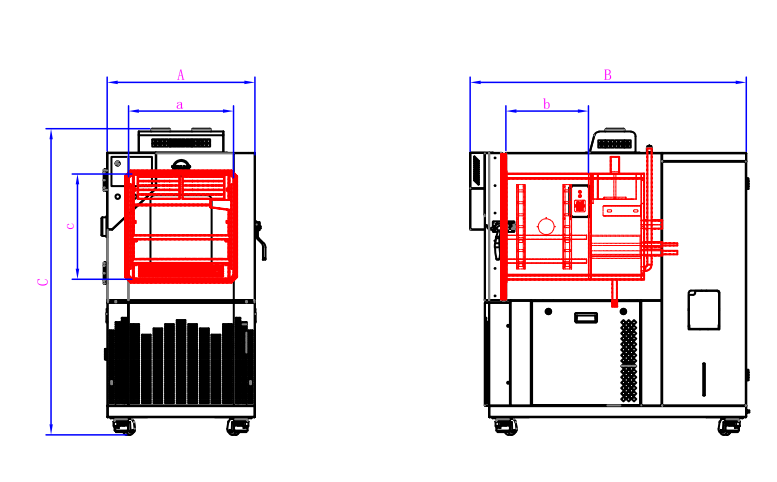
| model | PW-CTS3-80-40 | PW-CTS3-150-40 | PW-CTS3-250-40 |
|---|---|---|---|
| Volume (L) | 80L | 150L | 250L |
| a | 500 | 500 | 700 |
| b | 400 | 600 | 500 |
| c | 400 | 500 | 700 |
| A | 1650 | 1800 | 1500 |
| B | 1700 | 1850 | 1850 |
| C | 1780 | 1900 | 2300 |
| Pₘₐₓ | About 20KW | About 23KW | About 30KW |
| Voltage V | 380 | 380 | 380 |
Dongguan, China
+86 769-85842789
pw@pw-test.com
By continuing to use this website, you consent to the use of cookies in accordance with our Cookie Policy.
Accept