Description
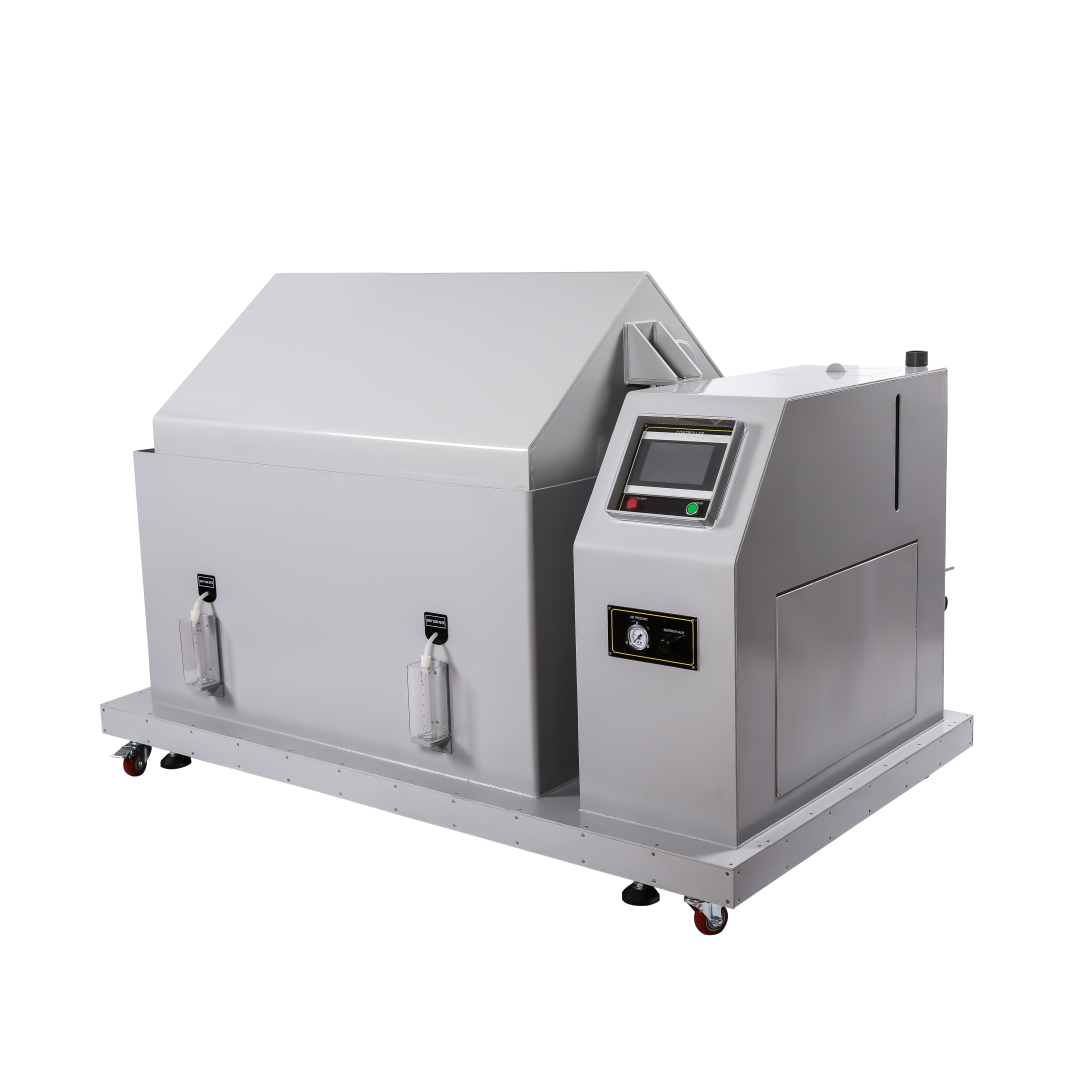
PW-CCT960 Composite Corrosion Resistance Test Chamber
Introduction:
Our company offers a salt spray test chamber that is designed to examine the corrosion resistance of products. This is done by subjecting the surfaces of different materials to corrosion treatments such as electroplating, anodizing, spraying, and anti-rust oil.

Specification:
| Model | PW-CCT960 |
| Internal size | 160x100x60(WxDxH)cm |
| External size | 265X145X172 (WxDxH) cm without temperature and humidity host (W125*D60*H110) |
| Power supply | AC3ø 380V 30A 50HZ |
| Test box interior | The PP is integrally formed, the thickness is 10mm, and the temperature resistance of the material can reach -10~90ºC, so that our equipment will not be deformed for a long time using CASS, ACSS and NSS tests. |
| Thermostatic case | GRP and PP gray temperature-resistant and impact-resistant board are used, and PP board mainly plays the role of protection and beautification. |
| Chamber upper cover | It adopts PP one-piece molding, the thickness is 10mm, and the temperature resistance of the material can reach -10~90ºC, so that our equipment will not be deformed for a long time in the CASS, ACSS, NSS test (automatic opening and closing). |
| Test refill drum | Using PP white board, the capacity is 100L. |
| Test chamber basket frame | Using GRP temperature-resistant angle material, the angle can be 20°±5° from the product test angle, and the test bracket can be customized. |
| Saturated air drum | Made of SUS#304 stainless steel plate, thickness 2mm, with automatic water level controller to avoid the inconvenience of manual water addition. |
| Salt spray test method | (1) Laboratory: 35ºC±2ºC (2) Saturated air barrel: 47ºC±2ºC |
| Corrosion resistance test method | (1) Laboratory: 50ºC±2ºC (2) Saturated air barrel: 63ºC±2ºC |
| Temperature and humidity drying test | Laboratory temperature: 40ºC~60ºC±1 Humidity: 30±5%RH and natural humidity drying, damp heat control system: internal installation of humidifier, dehumidifier, heater, circulating fan, drainage device, water supply device, water level controller, over-temperature protector, humidification pipe anti-drying The device, circulating air duct, damper, etc. use a circulating fan for strong air supply and circulation, built-in air space, stainless steel circulating fan, through the damper and diffuser, the air is blown out from the air duct evenly, and the temperature and humidity in the mixing room are adjusted well. Distributed to the test space, so as to achieve the purpose of uniform temperature and humidity control. |
| Damp heat test | GB2423.3-93 “Basic Environmental Test Procedures for Electrical and Electronic Products” Test Ca: constant damp heat test method. (Here is just a test that meets the specified temperature and humidity) a. Test temperature: 23~50ºC±2ºC. b. Test humidity: 45%~98%±2%RH |
Product Advantages
Design Innovations and Structural Reliability
The PW-CCT960 features a well-balanced construction using a reinforced PP interior providing chemical resistance against salt spray agents, paired with a durable GRP outer shell for structural integrity. Its automatic upper test cover streamlines specimen handling and reduces operator fatigue. Customizable fixture systems adapt to varied sample geometries, allowing optimized placement and maximizing test chamber utility. The inclusion of a 100-liter saturated air drum and robust thermal regulation components contributes to extended uninterrupted test cycles. Such design decisions underscore the chamber’s resilience under corrosive environmental stress, demonstrating why this equipment embodies trusted solutions among premier corrosion test chamber manufacturers and reinforces the value proposition of a high-grade salt fog test chamber.
Performance Efficiency and Operational Benefits
Equipped with precise environmental conditioning — involving humidity control, temperature modulation, and salt spray consistency — the PW-CCT960 delivers highly reproducible corrosion resistance data critical for engineering validation and compliance verification. User-friendly automated mechanisms simplify routine operation while minimizing manual intervention and reducing the potential for human error. The expanded interior volume supports batch processing, enhancing throughput for production workflows. Additionally, the chamber’s compatibility with NSS, CASS, and ACSS cyclic corrosion test protocols addresses diverse corrosion testing requirements encountered by laboratories specializing in surface treatment durability. This combination of steady performance and usability positions the unit as an effective tool for professionals invested in reliable salt spray corrosion chamber technology.
Use Scenarios
Application in Automotive and Aerospace Material Evaluation
In automotive and aerospace manufacturing environments, materials and components undergo rigorous corrosion resistance certification prior to assembly and market release. The PW-CCT960 functions as a core testing apparatus to simulate long-term saline atmosphere exposure using standardized salt spray corrosion chamber protocols, validating surface coatings and finishes. Its ability to maintain consistent cycle conditions for NSS, CASS, and ACSS testing enables accurate prediction of corrosion behavior under operational stresses. This chamber supports engineering teams in assessing protective material performance, ensuring compliance with industry corrosion standards, and integrating test results into comprehensive quality management systems. The test chamber’s reproducibility increases confidence in materials selection and failure risk mitigation across critical transportation sectors.
Role in Electronics and Metal Fabrication Quality Assurance
For electronics manufacturers and metal fabrication plants, corrosion effects can significantly impact product reliability and lifespan. The PW-CCT960 serves as an essential corrosion test chamber that provides accelerated salt fog and cyclic corrosion exposures to examine coating integrity and electroplated surface durability. Its controlled internal environment ensures uniform salt fog distribution and environmental stability necessary for consistent assessment across batches. Integrating this chamber into production line quality assurance and R&D testing routines facilitates early detection of potential corrosion failures and supports iterative improvement of protective treatments. By aligning test protocols with recognized standards, the chamber enhances traceability, compliance, and documentation essential for regulated industries relying on dependable corrosion resistance validation.
FAQ
What corrosion test methods does the PW-CCT960 support?
Our PW-CCT960 composite corrosion resistance test chamber supports multiple salt spray test cycles, including NSS, CASS, and ACSS. These are industry-standard methods designed to simulate real-world corrosion environments effectively, ensuring comprehensive corrosion testing within a robust corrosion test chamber.
Can I customize the test brackets or fixtures in the PW-CCT960?
Yes, we offer customizable test brackets and fixtures to fit different sample sizes and shapes. This flexibility enables you to adapt the chamber for specific testing requirements, supporting precise and reliable results for your cyclic corrosion test chamber applications.
What is involved in the installation and commissioning of the PW-CCT960?
We provide expert installation and hands-on training as part of our service. A qualified technician will guide your installation personnel and verify all safety and performance aspects. This ensures your environmental test chamber operates correctly from the start, minimizing downtime and setup risks.
How do you handle maintenance and spare parts for the PW-CCT960?
We maintain a comprehensive inventory of spare and wearing parts and offer preventative maintenance services. Our goal is to minimize your downtime by providing timely delivery of parts and professional upkeep. This ensures sustained performance and longevity for your salt spray corrosion test chamber.